
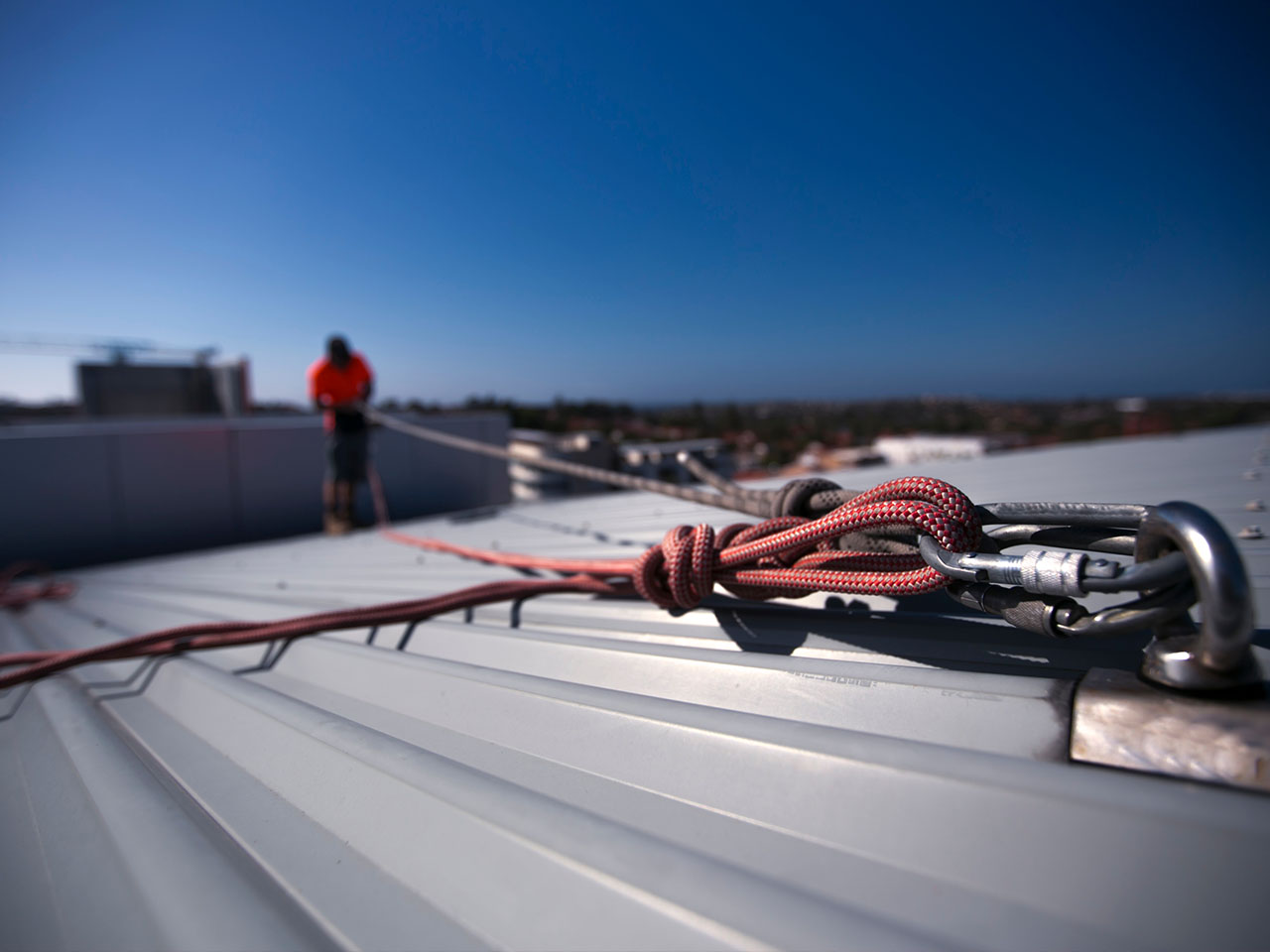
Every eyebolt, roof anchor, and fixed anchor device on a commercial or industrial building is a safety-critical component. The Working at Height Regulations 2005 place a clear legal duty on dutyholders — including building owners, facilities managers, and principal contractors — to ensure that all equipment used for work at height is suitable, inspected to a defined schedule, and certified by a competent person.
Under Regulation 12 of PUWER 1998 (the Provision and Use of Work Equipment Regulations), anchor devices constitute work equipment and are therefore subject to mandatory inspection and maintenance requirements. Failure to inspect, test, and certify eyebolts and roof anchor points to the appropriate standard is not merely a compliance failure — it is a potential criminal liability under the Health and Safety at Work etc. Act 1974.
A failed or improperly installed anchor device places any operative working at height — a window cleaner, rooftop maintenance technician, or building inspector — at immediate risk of a fatal fall. The consequences for the dutyholder in the event of an incident involving an uncertified anchor point include prosecution, unlimited fines, and custodial sentences.
CCR Maintenance Ltd provides a complete eyebolt and anchor device service delivered within an ISO 9001 quality management system and under ISO 45001 occupational health and safety procedures. Every engagement is managed at director level. Every certificate is traceable, auditable, and issued under the UK’s only triple ISO accredited rooftop compliance management system.
DUTYHOLDER OBLIGATION
Regulation 5 of the Working at Height Regulations 2005 requires that no person shall use equipment for work at height unless it is suitable, inspected, and its condition recorded. Anchor devices that have not been inspected and certified within required intervals must not be used. CCR Maintenance Ltd issues fully documented inspection records following every assessment.
Standard | Full Title | Scope |
BS EN 795:2012 | Protection Against Falls from Height — Anchor Devices | Specifies performance requirements and test methods for anchor devices. Defines anchor classes A1, A2, B, C, D and E. The primary product standard. |
BS 7883:2005 + A1:2008 | Application and Use of Anchor Devices Conforming to BS EN 795 | Code of practice for planning, selection, design, installation, commissioning, inspection and maintenance. The primary operational guidance standard for UK practice. |
PUWER 1998 | Provision and Use of Work Equipment Regulations 1998 | Requires anchor devices (as work equipment) to be maintained in efficient state, in efficient working order and in good repair. Periodic inspections must be carried out and recorded. |
Working at Height Regulations 2005 | SI 2005 No. 735 | Requires equipment for work at height to be suitable, inspected, and that inspection records are maintained. Establishes hierarchy prioritising collective over personal protection. |
BS EN 365:2004 | PPE Against Falls — General Requirements for Instructions and Periodic Inspection | Specifies requirements for periodic inspection of all personal fall protection components including anchor devices. |
CDM Regulations 2015 | Construction (Design and Management) Regulations 2015 | Require principal designers and contractors to incorporate permanent anchor devices into building design and provide maintenance information in the Health and Safety File. |
HSE Guidance Note GS33 | Falls from Height Prevention | Practical HSE guidance on selection and use of fall prevention measures including permanent roof anchors. |
BS EN 795 Class | Type | Technical Description |
Class A1 | Single anchor — vertical/inclined surfaces | Fixed to vertical or inclined surfaces such as facades and parapets. Static test load 18 kN. Proof load 6 kN. |
Class A2 | Single anchor — roof surfaces | Fixed to roof surfaces at an angle to the horizontal. The primary class for commercial rooftop eyebolt installations. Static test load 18 kN. |
Class B | Portable temporary anchor device | Removable, non-fixed anchor for use where a permanent anchor is impractical. Typically for rooftop plant rooms or clerestory windows. |
Class D | Horizontal rigid anchor rail | Rail systems and rigid horizontal tracks providing continuous fall arrest along a defined travel route on industrial rooftops. |
Class E | Dynamic anchor — deadweight system | Resistance to extraction provided by mass alone. Deployed on flat roofs where membrane penetration must be avoided. |
At CCR Compliance, we combine technical expertise, certified systems, and a commitment to safety to deliver fully compliant rooftop solutions you can rely on. From installation through to inspection and certification, our focus is on protecting people, reducing risk, and ensuring every system performs exactly as it should.
CCR Compliance delivers robust, dependable rooftop safety systems designed to protect individuals working at height, ensuring long-term safety, performance, and compliance.
Our specialists bring in-depth knowledge of UK regulations and industry best practice, ensuring every installation, inspection, and test is fully compliant and correctly engineered.
We use high-grade materials and certified installation methods to guarantee durability, reliability, and full regulatory compliance across all systems.
Serving clients across the UK, we provide consistent, accessible compliance services wherever they are needed.
We continually adopt the latest technologies and industry advancements to improve safety, efficiency, and compliance standards across all rooftop systems.
We build long-term partnerships through transparency, clear reporting, and dependable service, giving clients complete confidence in every inspection, installation, and certification.