
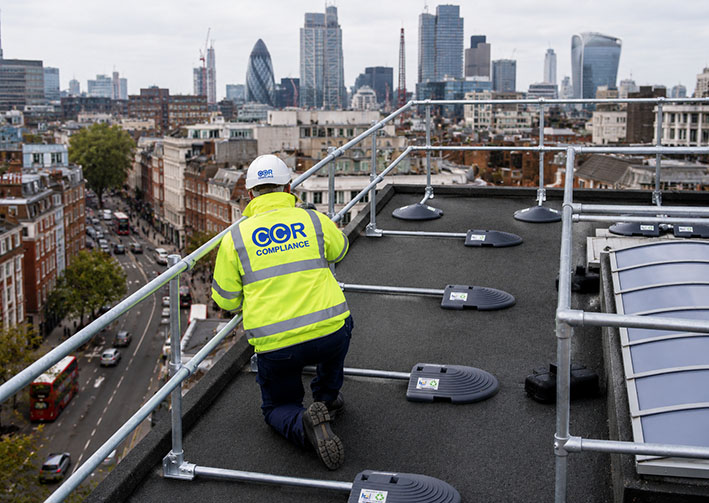
The Working at Height Regulations 2005 establish a legally binding hierarchy of control. Regulation 6 requires that, where work at height cannot be avoided, the dutyholder must first consider collective protection measures — those which protect all persons at risk without requiring individual action — before resorting to personal protective equipment (PPE) such as harnesses and lifelines.
Edge protection systems — guardrails, parapet upstands, and perimeter barriers — are the primary collective protection measure for rooftop work. They protect not only those carrying out planned maintenance, but also any person who may approach the unprotected edge during an emergency, inspection, or incident response. Collective protection is non-prescriptive: it functions regardless of whether the individual is wearing, checking, or correctly connected to personal fall protection equipment.
For principal contractors, CDM dutyholders, and building owners, this creates both a legal obligation and a significant risk management imperative. A building without compliant edge protection has no collective protection defence against a working at height incident. A building with a correctly designed, installed, and maintained system provides documented collective protection satisfying Regulation 6 and Schedule 2 of the Working at Height Regulations 2005 and the minimum standards of BS EN 13374:2018.
CCR Maintenance Ltd designs, installs, inspects, and certifies edge protection systems for commercial, industrial, and heritage buildings across the UK — all delivered under our Triple ISO accredited management systems.
CDM 2015 DUTYHOLDER OBLIGATION
The Construction (Design and Management) Regulations 2015 require that the Principal Designer and Principal Contractor ensure edge protection and fall prevention measures are incorporated into building design and documented in the Health and Safety File. CCR Maintenance Ltd supports CDM dutyholders in meeting these obligations and provides CDM-compatible documentation on completion of every installation.
Standard | Full Title | Scope |
BS EN 13374:2018 | Temporary Edge Protection Systems — Performance Requirements | The primary UK and European standard. Defines three performance classes (A, B, C) based on roof slope and dynamic load requirements. |
Working at Height Regs 2005 — Schedule 2 | Minimum Requirements for Guardrails and Working Platforms | Specifies minimum guardrail height (950mm), intermediate rail requirements (max 470mm gap), and toeboard minimum height (150mm). |
CDM Regulations 2015 | Construction (Design and Management) Regulations 2015 | Require collective fall protection to be addressed at design stage and documented in the Health and Safety File. |
PUWER 1998 | Provision and Use of Work Equipment Regulations 1998 | Where edge protection constitutes permanent work equipment, periodic inspection and record-keeping obligations apply. |
BS EN ISO 14122-3:2016 | Safety of Machinery — Permanent Means of Access — Guard-rails | Applicable where edge protection is provided on industrial plant access routes, specifying strength and dimensional requirements. |
HSE Guidance INDG401 | Working at Height: A Brief Guide | Reinforces the hierarchy of control and primacy of collective protection. |
BS 5395-3:1985 | Stairs, Ladders and Walkways — Industrial Type | Applicable where edge protection is associated with fixed access routes or roof walkways. |
BS EN 13374:2018 classifies temporary edge protection into three performance classes determined by the slope of the protected surface and the dynamic load the system must resist. Selecting the incorrect class invalidates the protective function. CCR Maintenance Ltd specifies the correct class following a detailed roof geometry assessment.
BS EN 13374 Class | Application | Technical Requirements |
Class A | Surfaces up to 10° slope | Static loads only. For flat or very shallow-pitched roofs. System must resist horizontal static force. Minimum guardrail height 1000mm, intermediate protection required, maximum vertical gap 470mm, toeboard minimum 150mm. |
Class B | Surfaces 10° to 30° slope | Combined static and dynamic loads. For moderately pitched roofs. Must resist both horizontal static force and a dynamic impact load representing the energy of a person sliding toward the edge. |
Class C | Surfaces 30° to 45° slope | Arrest of a rolling person. Highest performance class. For steeply pitched roofs where a person may roll from apex to edge at speed. Complex structural requirements for base fixings and guardrail components. |
At CCR Compliance, we combine technical expertise, certified systems, and a commitment to safety to deliver fully compliant rooftop solutions you can rely on. From installation through to inspection and certification, our focus is on protecting people, reducing risk, and ensuring every system performs exactly as it should.
CCR Compliance delivers robust, dependable rooftop safety systems designed to protect individuals working at height, ensuring long-term safety, performance, and compliance.
Our specialists bring in-depth knowledge of UK regulations and industry best practice, ensuring every installation, inspection, and test is fully compliant and correctly engineered.
We use high-grade materials and certified installation methods to guarantee durability, reliability, and full regulatory compliance across all systems.
Serving clients across the UK, we provide consistent, accessible compliance services wherever they are needed.
We continually adopt the latest technologies and industry advancements to improve safety, efficiency, and compliance standards across all rooftop systems.
We build long-term partnerships through transparency, clear reporting, and dependable service, giving clients complete confidence in every inspection, installation, and certification.
The class is determined by roof slope at the point of installation. Class A for surfaces up to 10°. Class B for 10°–30°. Class C for 30°–45°. Most flat commercial rooftops require Class A. CCR Maintenance Ltd carries out a site-specific assessment to confirm the correct class before specifying any system.
Not always, but the starting point is the Working at Height Regulations 2005 Regulation 6 hierarchy: collective protection must be considered first. Where roof access is required for any purpose, the dutyholder must assess whether permanent edge protection is the most practicable collective protection measure. For regularly accessed roofs, permanent edge protection is almost always the appropriate solution. CCR Maintenance Ltd provides a compliant documented assessment to support this decision.
Schedule 2 of the Working at Height Regulations 2005 specifies a minimum of 950mm, with intermediate protection ensuring no gap exceeds 470mm. CCR Maintenance Ltd recommends a minimum of 1,100mm for all new permanent commercial installations, consistent with industry best practice and CDM guidance. Toeboards must be at least 150mm.
Yes. Where edge protection constitutes permanent or semi-permanent work equipment under PUWER 1998, periodic inspection by a competent person is required. The Working at Height Regulations 2005 also require that working platforms are inspected before use and at suitable intervals. CCR Maintenance Ltd provides periodic inspection and issues full reports and compliance certificates.
Yes. Non-penetrating systems including counterweight base and weighted-base proprietary guardrail systems are available for flat roofs where membrane penetration is undesirable. CCR Maintenance Ltd confirms the roof structural capacity under counterweight loading before recommending a non-penetrating solution.
Uncertified guardrail systems have no documented structural basis. The correct action is an immediate competent-person inspection confirming dimensional compliance, fixing integrity, and system class. CCR Maintenance Ltd carries out retrospective inspections, issues compliance or non-compliance certificates, and provides a clear remedial programme.