
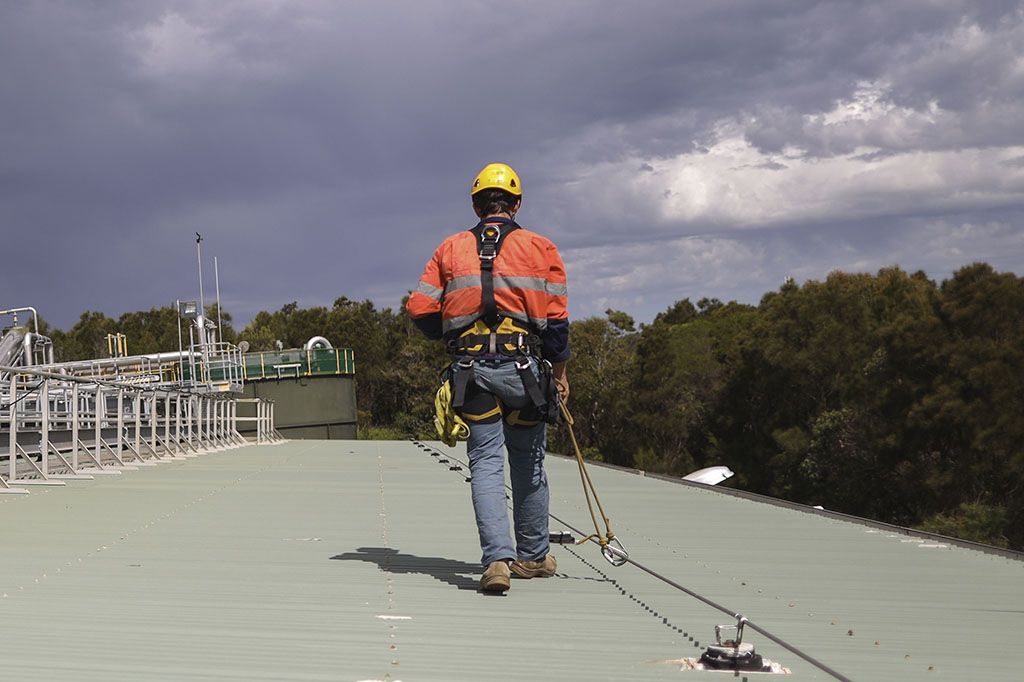
The Working at Height Regulations 2005 hierarchy of control prioritises collective protection — such as edge protection and guardrails — over personal protective equipment. However, there are many rooftop environments and maintenance tasks where collective protection of the entire roofscape is not reasonably practicable: access routes on pitched or barrel-vault roofing, movement around rooftop plant, maintenance of linear gutters and valley sections, or any activity requiring movement along an unprotected edge over an extended distance.
In these circumstances, a mansafe system — formally a horizontal flexible anchor line system, classified under BS EN 795:2012 Class C and designed to BS EN 353-2:2002 (Guided Type Fall Arresters on Flexible Anchor Lines) — provides continuous fall arrest protection for an operative moving along the system without requiring them to unclip and re-connect at multiple anchor points.
A correctly designed and installed mansafe system eliminates the gap in fall arrest protection inherent in single-point anchor systems, where the operative must unclip from one anchor and expose themselves to unprotected fall risk whilst transitioning to the next. The continuous traveller mechanism ensures the operative is connected at every point along the protected route.
CCR Maintenance Ltd designs, installs, commissions, inspects, and certifies mansafe systems for commercial and industrial buildings across the UK — all with full fall clearance calculations, compliance certification, and director-level technical oversight on every project.
CRITICAL SAFETY NOTICE
The design of a mansafe system is a structural engineering exercise — not a product installation. An incorrectly designed horizontal lifeline can, in the event of a fall, generate anchor loads far exceeding those anticipated, fail the end anchors, or result in the operative striking the roof surface before the fall is arrested. Every CCR Maintenance Ltd mansafe installation is preceded by full fall clearance calculations confirming system geometry, sag distance, arrest distance, and total fall clearance for the specific roof geometry.
Standard | Full Title | Scope |
BS EN 795:2012 (Class C) | Protection Against Falls — Anchor Devices — Horizontal Flexible Anchor Lines | Defines Class C horizontal flexible anchor line systems (mansafe/lifelines). Class C systems must arrest the fall of two persons simultaneously. Governs end anchor structural requirements. |
BS EN 353-2:2002 | Guided Type Fall Arresters — Flexible Anchor Lines | Specifies design, testing, and performance of guided fall arresters on flexible anchor lines — including the traveller mechanism and combined system performance. |
BS EN 363:2008 | Personal Fall Protection Equipment — Fall Arrest Systems | Governs complete fall arrest systems. Defines maximum arrest force on the body (6 kN) and maximum free fall distance (4 m without energy absorber). |
BS EN 354:2010 | PPE Against Falls — Lanyards | Governs lanyards connecting harness to mansafe traveller. Specifies breaking strength, length, and dynamic performance. |
BS EN 355:2002 | PPE Against Falls — Energy Absorbers | Specifies ripstitch and webbing tear lanyards used to limit arrest force transmitted to the operative. |
BS EN 360:2002 | PPE Against Falls — Retractable Type Fall Arresters | Governs self-retracting lifelines (SRLs) used as the connecting element between the user and the mansafe traveller. |
BS EN 361:2002 | PPE Against Falls — Full Body Harnesses | A full body harness is the only permissible body support for fall arrest applications under BS EN 363. |
BS EN 365:2004 | PPE Against Falls — General Requirements for Inspection | Specifies periodic inspection frequency and competence requirements for all PPE components including anchor lines, travellers, and anchors. |
PUWER 1998 | Provision and Use of Work Equipment Regulations 1998 | A mansafe system and all components constitute work equipment requiring periodic inspection, maintenance, and records. |
Working at Height Regulations 2005 | SI 2005 No. 735 | Requires all fall arrest equipment to be suitable, inspected, and used only by trained and competent persons. |
The primary technical safety variable in any mansafe installation is the total fall clearance — the minimum vertical distance between the operative’s harness attachment point and any obstruction below that the system must provide to arrest a fall before the operative contacts the obstruction. CCR Maintenance Ltd carries out full fall clearance calculations for every new installation, incorporating:
Regarding anchor loads under arrest: Under BS EN 795:2012 Class C, a mansafe system must resist the arrest of two persons simultaneously. End anchor loads generated by a two-person arrest on a horizontal flexible anchor line can significantly exceed 20–25 kN in some configurations. All CCR Maintenance Ltd designs confirm the structural adequacy of proposed anchor points for worst-case arrest loads.
At CCR Compliance, we combine technical expertise, certified systems, and a commitment to safety to deliver fully compliant rooftop solutions you can rely on. From installation through to inspection and certification, our focus is on protecting people, reducing risk, and ensuring every system performs exactly as it should.
CCR Compliance delivers robust, dependable rooftop safety systems designed to protect individuals working at height, ensuring long-term safety, performance, and compliance.
Our specialists bring in-depth knowledge of UK regulations and industry best practice, ensuring every installation, inspection, and test is fully compliant and correctly engineered.
We use high-grade materials and certified installation methods to guarantee durability, reliability, and full regulatory compliance across all systems.
Serving clients across the UK, we provide consistent, accessible compliance services wherever they are needed.
We continually adopt the latest technologies and industry advancements to improve safety, efficiency, and compliance standards across all rooftop systems.
We build long-term partnerships through transparency, clear reporting, and dependable service, giving clients complete confidence in every inspection, installation, and certification.